Two things decide whether employee of the month means anything, and the artwork is neither of them. One is the sentence you write about the person. The other is whether anybody can explain how they got picked.
An employee of the month template can't do either of those for you. What it can do is save an hour of fighting with text boxes, so the layouts below are specified line by line, in enough detail to rebuild any of them in Canva or Word in about ten minutes. Then comes the wording, where these awards are usually won or lost, and the criteria question, where they quietly die.
Why most downloads get printed once
A template is a formatting problem. You solve it once and you're done. What kills these programs is never the layout.
Gallup puts a number on the gap. Just 22% of employees say they get the right amount of recognition for the work they do, and more than half get either nothing or recognition that fails every quality measure Gallup tracks. Companies aren't short of certificates. They're short of specificity and fairness, and neither of those ships in a Word file.
There's a second reason the downloads go stale. They're built around a blank, and a blank invites the laziest possible fill. Hand a manager "presented to ______ for ______" at 11pm the night before the all-hands and you'll get "outstanding performance" every time. Then nobody reading the sign learns what the winner did, or what might get them named next month. So build the template so the vague answer doesn't fit. A citation field sized for thirty words, positioned as the second-largest element on the page, forces a real sentence out of whoever fills it in.
Free employee of the month templates
Two ready-made versions in Canva, both deliberately plain so your own colors and logo drop straight in. Open one, hit Use template, and it copies into your own Canva account. Change anything you like from there. If you'd rather build from scratch, the specs in the next section give you every measurement.
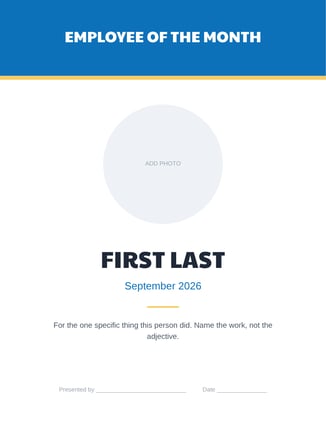
Wall sign, 8.5 x 11 inches
Portrait, prints on any office printer. A photo circle, the name, the month, and a citation line sized so a real sentence fits and "outstanding performance" looks lost.
Open in Canva →
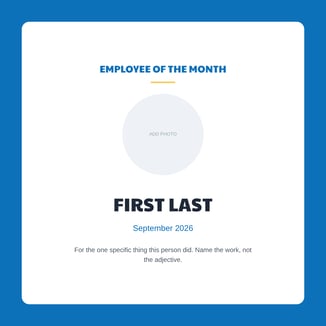
Digital post, 1200 x 1200 px
The square version for Slack, Teams, LinkedIn or Instagram. Same four fields, so the sign on the wall and the post in the channel say the same thing.
Open in Canva →
Both are sized to the specs below. Swap the placeholder photo for a real one, and write the citation line before you write anything else. It's the part people read.
Four employee of the month template layouts
Each of these is a build spec. Canva's US Letter preset, Google Slides with a custom page size, and plain Word all handle them. Set your brand color once, save a master, then duplicate it monthly and change three fields.
1. The wall sign, 8.5 x 11 inches, portrait
Your default. It fits every printer in the building and every spare frame in the supply closet. Margins at 0.75 inch, and from the top down:
- Program name in small caps, 18pt, letter-spaced about 0.1em, in your brand color, an inch and a quarter from the top edge. "EMPLOYEE OF THE MONTH" and nothing else.
- Month and year underneath at 14pt in gray. September 2026, not 09/26.
- A photo, 3.5 inches square, centered. Square crops are forgiving of the pictures people actually have of themselves.
- The name at 44 to 54pt bold, the biggest thing on the page by a wide margin.
- Job title and team at 16pt, gray. "Warehouse Lead, Second Shift" tells a visitor more than "Operations."
- The citation at 14pt italic, centered, hard-capped at two lines. This field earns the sign its wall space.
- Logo at the foot, no wider than an inch.
Leave off the clip-art trophy, the starburst, the scroll border, the drop shadows and the exclamation points. Leave off the word "winner" too, because a winner implies a room full of losers and everyone in that break room does the math instantly. Skip the signature line, since a squiggle on a ruled line makes a sign look like a processed form.
2. The frame insert, 5 x 7 inches, landscape
Buy one good frame, put it by the reception counter or the time clock, and swap the card monthly. A permanent frame saves you from a wall of curling paper.
Four elements, nothing more. Program name at 11pt small caps across the top. Name at 30pt bold, centered, in the middle third. Month and year at 10pt below it. One citation sentence at 10pt italic, twenty words maximum, on the bottom margin. No photo at this size, because a face reproduced at an inch and a half looks like a badge photo, and you've made a security pass instead of an award.
3. The certificate, 11 x 8.5 inches, landscape
Landscape is what makes a page read as a certificate instead of a memo, and it's the change most homemade versions miss. Set a hairline rule (0.5 to 1pt, solid, single, not the double ornamental kind) inset half an inch from the trim on all four sides. Inside it, stacked and centered:
- "Certificate of Recognition" at 26 to 30pt in a serif face. Georgia and EB Garamond both print well.
- "Employee of the Month" underneath at 18pt, letter-spaced, in your brand color, then "presented to" at 12pt in gray.
- Recipient name at 40pt, typed. Handwritten names look like a school fun run, and typed names survive being photographed for LinkedIn.
- The citation at 13 to 14pt over two or three lines, with line breaks you control.
- Month and year at 12pt.
- Two signature blocks at the foot, each about 2.5 inches wide. A 0.5pt rule with the signer's typed name and title at 10pt underneath.
Get both signatures wet. Everyone can spot a scanned signature graphic, so spend the eleven seconds. Have the second come from outside the recipient's reporting line, ideally the most senior person who'll agree to it. Gallup's data is blunt about that. Acknowledgment from a senior leader gets remembered out of all proportion to how often it happens.
4. The digital version, 1200 x 1200 px and 1920 x 1080 px
Most of your company never walks past the break room, so paper is a minority format.
Build a 1200 x 1200 square for Slack and Teams. Chat clients crop hard and preview at maybe 360px wide, so put the name in the top third at 90 to 110px and keep total text under twenty-five words. Build a 1920 x 1080 version for the all-hands deck, where the full citation fits at 40px. Write real alt text on both, and save the PNG where the recipient can reach it.
The employee of the month sign in physical terms
Signs fail on production details more often than design ones. Four to settle before you print.
Where it hangs. Somewhere the people whose opinion the winner cares about will actually see it, and that's rarely the lobby. The break room, the corridor to the lockers, the wall by the shift board. If half your team is remote, the pinned channel post is the primary location.
What it's printed on. 80 to 100 lb cover stock (roughly 215 to 270 gsm) in matte. Gloss photographs badly under fluorescent light, so every phone picture comes back with a glare stripe across the name. Copier paper in a frame is fine. Taped to drywall it curls in a fortnight and starts to look like a notice about the microwave.
How it prints. Set the dialog to Actual Size or 100%, never Fit to Page, or your careful 0.75 inch margins come out at 0.9. Photos need 300 dpi at print size. A phone photo is plenty. An avatar pulled out of Slack is 128 pixels and prints as a rectangle of oatmeal.
How big the name is. The rough signage rule is an inch of letter height per ten feet of viewing distance, so a 48pt name reads across a corridor and not across a warehouse.
The perpetual board, if you're committing
Twelve slots, one per month, with the year across the top. Cheap version is a 24 x 36 inch foamboard with twelve 5 x 7 card pockets, durable version an engraved plate board from a trophy shop. A board does one thing a rotating frame can't. It shows the pattern, because twelve names in a row is a public record of how the award gets handed out. Start a fresh board each year.
The employee of the month certificate
An employee of the month certificate has one job the sign doesn't. It goes home.
People keep these. They show them to a partner, they put them in a drawer, they scan them into a job application four years later. So the certificate is where production quality earns its keep, and the gap between kept and recycled is three dollars and one deliberate moment.
- Print on cardstock. The weight is most of the perceived value.
- Frame it before you hand it over, since an 11 x 8.5 landscape certificate drops into an off-the-shelf document frame. It also spares the recipient holding a loose sheet of paper for the rest of the meeting.
- Hand it across in person, in front of the people the work affected, and read the citation out loud. That part is the actual recognition. The paper is a receipt.
- Email the PDF afterwards, copying their manager's manager.
And cut the boilerplate. "In recognition of your outstanding contribution and dedication to the company" is nine words of nothing.
Employee of the month wording for the citation line
Here's the part almost everyone gets wrong, and the reason a good template still produces a weak award.
The citation names a specific action, says who it affected, and includes a number where one exists. Past tense, thirty words or fewer, and no adjectives about the person's character, because character adjectives can't be checked and everybody knows it. A usable formula: [what they did] + [who it affected or what it prevented] + [the number, if there is one].
Citation examples that work
- "Cleared the returns backlog from nine days to two, and called the twelve customers who had been waiting longest."
- "Caught a mislabeled pallet before it left the dock, so the Reno order shipped correctly instead of coming back as a recall."
- "Covered eleven shifts in June without being asked, including both days of the holiday weekend."
- "Trained four float nurses on the new charting system in her own scheduled downtime, so nobody hit the floor guessing."
- "Took the 6am migration calls for three straight weeks so the London team never had to stay late."
- "Answered 212 tickets in July with the highest satisfaction score on the team, and wrote the macro the rest of us now use."
None of those are compliments. They're descriptions. A description of what somebody did flatters them more than any adjective could, and it shows every other reader where the bar sits.
Wording to cut
- "For going above and beyond." Above and beyond what? Nobody can repeat it.
- "For her positive attitude." Attitude is not work, and attitude awards get handed out unevenly.
- "For consistently demonstrating our core values." Name the value and the moment instead.
- Anything hanging on "always" or "never." Those stand in for the example you didn't write.
For longer formats, our employee appreciation card templates and wording examples covers cards and notes, and we keep banks of employee appreciation quotes and staff appreciation quotes. Your own sentence beats a quotation every time, though.
Employee of the month criteria, and why they get published
Now the substance, and the reason so many of these quietly die.
Employees can tell an award from a rotation. They compare notes, they remember last year's winners, and they can map twelve names onto an org chart faster than you can. A monthly award with unpublished criteria doesn't read as neutral to them, it reads as political, because the only pattern anybody can see is who sits close to the person deciding. Running it in that state does more harm than not running it, since you've built a monthly reminder that recognition here goes to whoever the boss likes. Morale takes the hit even among people who never expected to win.
Published criteria fix this cheaply. Not perfectly. Cheaply.
What to publish
SHRM's toolkit on managing employee recognition programs is a reasonable structure to check yours against. Publish at least these seven things.
- Three to five criteria, maximum. Any more and the award recognizes everything, so it signals nothing.
- Who's eligible. Part-timers, contractors, new hires inside 90 days, managers, the leadership team. Answer it before somebody's nomination forces you to.
- How often one person can win. A twelve-month cooling-off period stops the program collapsing onto three high performers.
- Who nominates. Peers, managers, or both. Peer-driven awards spread wider, and peer-to-peer recognition catches work no manager is positioned to see.
- Who decides, and whether that's one person or a panel. A rotating panel seat is much harder to accuse of favoritism.
- What a nomination must contain. Require a specific example, which doubles as your draft citation.
- Where the criteria live. Post them next to the sign, because criteria filed somewhere nobody reads are the same as no criteria.
Criteria that hold up
Good criteria describe observable actions any employee could plausibly perform this month. Weak criteria describe personality traits, or outcomes only a couple of job families can produce. "Exceeded quota" is unusable, because most of your company has no quota. "Solved a customer or colleague's problem that wasn't theirs to solve" works everywhere, from the loading dock to accounts payable.
Watch the spread over a year. If eleven of twelve winners came from two departments, the problem isn't your nominators. It's criteria only one kind of job can satisfy.
Whether monthly is the right cadence
Monthly is heavy. Twelve genuine standout contributions a year in a company of thirty people is a stretch, and a program obligated to name a winner every month will eventually name one regardless. Quarterly with a real bar beats monthly with a soft one.
We go deep on the structural side (cadence, nomination flows, budget, and how to retire a program that's gone stale) in our guide to how to start an employee of the month program. Read that one before you launch, and use this one when you build the assets.
Employee of the month ideas that don't involve a printer
The sign announces the award. It isn't the award. These employee of the month ideas make the month feel different from the other eleven, and most cost nothing.
- A reserved parking spot with the winner's name on a card. Reliably the most fought-over item wherever parking is tight.
- The citation read out at the all-hands by someone senior. Warn them first if they'd hate the surprise.
- A note to the winner's manager's manager describing what they did. Visibility upward is a currency, and one of the few forms of non-monetary recognition that changes careers.
- An employee spotlight interview in the newsletter, using questions that produce real answers.
- A letter sent to their home address. Old-fashioned, and the household reaction is why it works.
- For remote winners, ship something physical the same week. Our notes on remote employee gifts cover the logistics, and remote staff are the easiest people to leave off a wall.
More in our low-cost employee appreciation ideas, and the context in how to motivate employees and high-performance company culture.
What to attach to the recognition
A certificate on its own is a real award. Plenty of programs run on nothing else, because recognition does the emotional work and a gift only amplifies it. But if there's budget, the gift shouldn't undercut the citation.
It commonly undercuts it in two ways. Sameness is the first, where the identical $25 card every month forever tells the recipient they've been processed by a system. Tax is the second. Cash and cash equivalents given to employees are generally taxable wages, and the IRS is direct that cash or cash equivalent items provided by the employer are never excludable from income, so a $100 gift card typically leaves the employee with meaningfully less than $100. We unpack that in are gift cards taxable and in our explainer on de minimis fringe benefits.
Letting the recipient choose fixes the sameness, since one budget produces a different gift for every winner. GiftYouPick™ and Turkey & Grocery Vouchers from Corporate Traditions are both designed to qualify as a tax-free de minimis fringe benefit, so the full budgeted value reaches the person, while Gift Card+™ covers 500+ options. Confirm your own structure with your tax or payroll advisor.
A monthly program also means ordering one gift twelve times a year, and platform minimums and annual contracts punish that pattern. Corporate Traditions carries no fees, no contracts and no minimum order quantities, and codes arrive in one to two business days. For the months you recognize a whole department, bulk gift cards absorb the volume, and a rewards program that flexes month to month is the point.
Whatever you choose, keep the value stable across the year. Varying it by month invites comparison between winners.
Employee of the month template FAQ
How do you make an employee of the month certificate?
Set up an 11 x 8.5 inch landscape page with a hairline border half an inch inside the trim, then stack six elements down the middle. "Certificate of Recognition" at around 28pt, "Employee of the Month" at 18pt, the name at 40pt, a two-line citation, the month and year, and two signature blocks. Print on cover stock and sign by hand.
What should you write on an employee of the month certificate?
One specific sentence about what the person did, who it affected, and any number attached. "Cleared the returns backlog from nine days to two" beats "for outstanding performance and dedication," because the first version shows every other employee where the bar sits.
What size should an employee of the month sign be?
8.5 x 11 inches portrait is the practical default, since it prints anywhere and fits standard frames. A 5 x 7 landscape insert works well in a permanent frame at reception. If people walk past quickly, go to 11 x 17 with the name at 72pt.
How do you choose employee of the month?
Publish three to five criteria any role could satisfy, take nominations that require a specific example, and have a small panel decide instead of one manager. Set a cooling-off period so the same few people can't win repeatedly, then review the spread across departments once a year.
How do you announce employee of the month?
Lead with the name, read the citation, then mention the award. Most companies open with the gift instead, and the whole thing sounds like a raffle result. Post the same wording in your company channel with the graphic.
How do you nominate a coworker for employee of the month?
Write down one thing they did, when it happened, and who it helped. Forms that ask for a specific example produce better awards than a box labeled "why does this person deserve it," and the nomination usually becomes the citation with light editing.